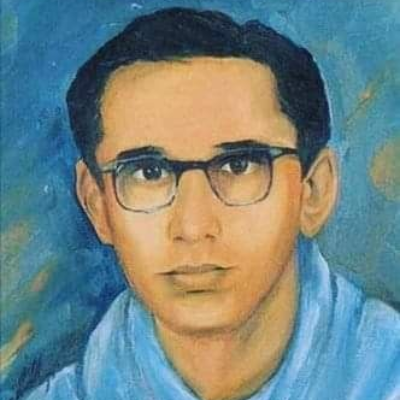
Sayad Hashmi
Sayad Hashmi, also known as Sayad Zahur Shah Hashmi (and spelled in various similar ways such as Syed Zahoor Shah Hashmi or Hashomi), was born on 21 April 1926 in Gwadar, Balochistan.(73) He received his primary education from the Saeedia School in Gwadar,(74) but there is only scanty information about later studies and employment. Sayad passed away on 4 March 1978.(75)
Sayad dedicated his entire life to developing his mother tongue, the Balochi language, and its literature. He is often called the father of Balochi. He was one of the founding members of the first Balochi literary circle in Karachi in 1952, The Balochi Zobánay Sarchammag. (76)
Sayad was first and foremost a poet. He began writing poems in Balochi in the late 1940s, when he was working at Radio Pakistan, Karachi. Previously he had written poetry in Persian and Urdu.(77) Among his collections of poetry in Balochi one can mention Sestagén Dastunk (Broken Ghazals),(78) Angar o Trungal (Embers and Hail),(79) Bretkagén Bir (Burnt Lightning),(80) Sechkánén Sassá (Intricate Thoughts),(81) Shakkalén Shahju (Sweet Streams of Water),(82) and Gesedgwár (Rain of Citrine).(83)
Sayad wrote a number of short stories as well, some of which have been published in Mirgend (Mirgend).(84) He is also famous for having written the first novel in Balochi, Názok (Nazok),(85) which depicts traditional life in the coastal town of Gwadar.(86) It was later translated into Urdu and Persian. He also wrote the screenplay for the first modern Balochi movie, Hammal o Mahganj (Hammal and Mahganj).(87)
Sayad was not only a fiction writer; he also wrote a history of the Balochi language and its literature in Urdu, Baluchi zuban u adab ki tarix.(88) Sayad is renowned and highly respected for his work as a language activist. One of the areas where he made important contributions is Balochi lexicography. He travelled to different parts of Balochistan documenting vocabulary in various dialects. He was also an active creator of neologisms.(89) Much of this vocabulary was published posthumously in the dictionary Sayad Ganj,(90) which is also available online.(91)
Another contribution for which Sayad is famous is his work on Balochi orthography. He presented a script for Balochi with a number of orthographic rules in his book Balóchi Syáhagay Rástnebisag.(92) Known as the Sayad Hashmi writing system, this was the first attempt to establish rules for writing Balochi.(93)
In 1983, the Sayad Hashmi Academy was founded in Karachi with the purpose of keeping Sayad’s name and contributions to the development of the Balochi language alive.(94) Other institutions have also been named after him, including a high school in Turbat,(95) a library in Gwadar,(96) and an important reference library in Karachi founded by another language activist, Saba Dashtyari, in order to gather publications on Balochi, the Baloch and Balochistan in one place.(97)
The story by Sayad Hashmi in this anthology, Gárén Kaldár (The Lost Coin), is a touching portrait of loneliness, longing, and love. Contrary to most of the other stories presented in this book, it ends on a positive note.
Stories by this Author
The Lost Coin
It was a summer day. The sun was high in the sky. Early in the morning he had left for the beach and now he was sitting on the shore. There was still a touch of last night’s chill in the sand. He cast a look at the foamy wave...