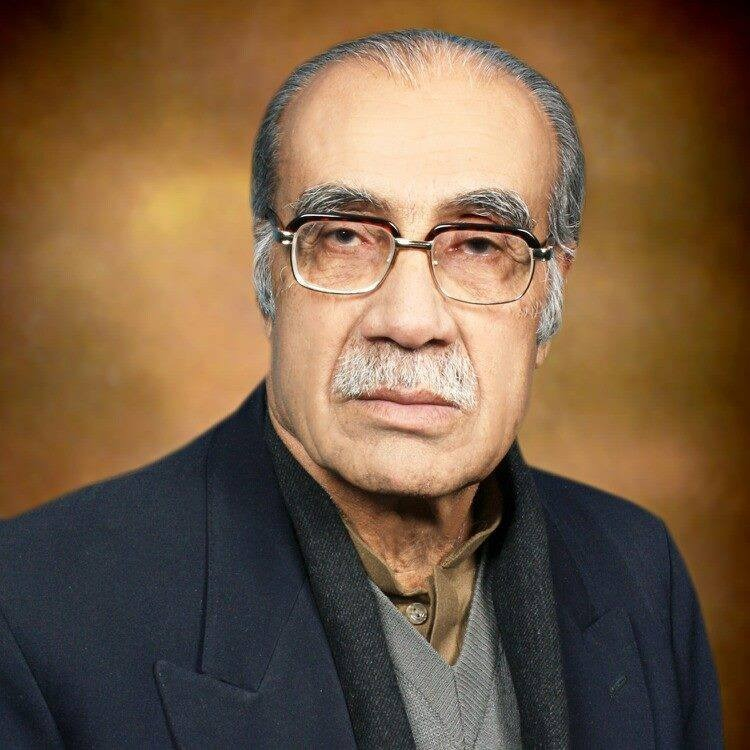
Naimatullah Gichki
Naimatullah Gichki (also spelled Niamatullah or Nematullah Gichki) was born on 18 April 1942 in Sordo, Panjgur, Balochistan. (62) After his matriculation exam in Panjgur in 1958, he continued his studies in Quetta and Karachi, earning his Bachelor of Medicine, Bachelor of Surgery (MBBS) degree in 1967. He then began work as a medical doctor in Panjgur. Later he travelled to the USA and Germany for further education and earned MA degrees in medicine in both these countries.
Naimatullah subsequently moved to Quetta, where he taught medicine for many years at Bolan Medical College, and toward the end of his active career he was the principal of this college. In the 1980s, he was also head of the WHO Malaria Control Programme in Balochistan. (63)
As a college student, Naimatullah developed an interest in literature and began writing short stories. His stories have been published in different magazines. Some were also gathered and published in a number of short story collections, including Mehray Tayáb (The Shore of Love), (64) Kawray Patár (Flood Debris), (65) Shakkal o Zahráp (Sweet and Bitter), (66) Arwahay Ars (Tears of the Soul), (67) and Támórén Bámgwáh (Dusky Dawn). (68)
Naimatullah translated a numbers of short stories by internationally renowned writers into Balochi and compiled them into a book published in 2021 with the title Gat o Gomán (Imaginations). (69) He has also translated some of his own Balochi stories into English. Several of these, together with his translations of selected stories by other Balochi writers, were published by the Pakistani Academy of Letters under the title Shooting Star. (70)
In addition to fiction, Naimatullah has also written a travelogue, Shap Jáh o Róch Jáh (Always on the Move), (71) in which he retells his journeys to various countries. He has written a book on the nationalist struggle of the Baloch as well, Baloch in Search of Identity, (72) and numerous articles on medical topics. He is still active as an editor of a medical journal at Bolan Medical College.
The story presented in this book, Peti Mirás (Patrimony), paints a realistic picture of a conflict over an inheritance, and at the same time depicts the situation in Balochistan, where many mothers are deprived of their children in different ways and end their lives in loneliness.
Stories by this Author
Patrimony
Uffff… Dear God, what shall I do? How did I become so helpless! I have strength, yet I’m helpless. I have relatives, yet I’m desolate. Ufffff… My throat is dry. No one gives me as much as a drop of water. My body is entirely ...