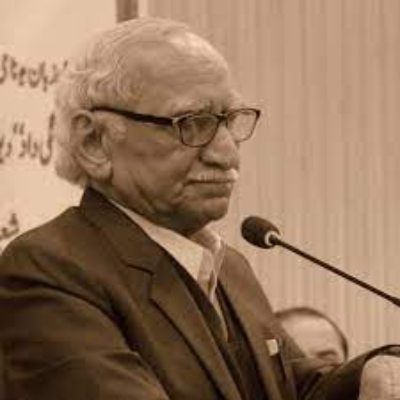
Ghani Parwaz
Ghani Parwaz (also spelled Gani Parwaz) was born on 15 August 1945 in Nezarabad, Kech District, Balochistan. He received his basic education in Nezarabad and holds a B.Ed. and two MA degrees, one in Urdu and one in Political Science. He also has a degree corresponding to an MA in Balochi. He has worked as a schoolteacher, headmaster, lecturer and professor of Political Science in Turbat. Now retired, he still lives in Turbat.
Parwaz is a champion of Human Rights, and for many years he has been active in the Human Rights Commission of Pakistan, where he is the head of the Special Task force in the Makran region. He also actively advocates for women’s rights in Pakistan in general and Balochistan in particular.
Parwaz has been interested in literature since a young age, and he is a very productive author. He has published numerous works in different genres. His non-fiction prose treats both political and literary subjects. For political subjects, he prefers to write in Urdu, whereas his literary criticism is mostly in Balochi. He has also published two collections of poetry, Mósom Ent Wadáráni (It is the Waiting Season) (102) and Kassi Naán Mátén Watan (I am No One’s Motherland). (103)
Parwaz is, however, most renowned as a writer of prose fiction, and he has published several collections of short stories and a number of novels. His first collection of short stories, Sánkal (Iron Chains), (104) was published in 1992, and his latest collection, Distagén Wáb o Nadistagén Máná (Seen Dreams and Unseen Meanings), (105) was published in 2021. Ghani Parwaz has also published five novels, the first, Mehray Hóshám (Craving for Love), in 2000, (106) and the latest one, Máhay Sar o Róchay Chér (On the Moon and Under the Sun), (107) in 2017. Mehray Hóshám was republished by the Balochi Language Project (108) in 2015. (109) Parwaz has also written novels and short stories in Urdu.
After a journey to Sweden between December 2013 and January 2014 during which he visited the Balochi Language Project, Parwaz wrote a travelogue which he published in 2016 under the title Wábáni Dawár (The Abode of Dreams). (110)
In 1997 Parwaz received Mast Tauk Ali (111) award for his first collection of Balochi short stories, Sánkal (Iron Chains), (112) and he was given the same award in 1998 for his book of literary essays Labzánki Shargedári (Literary Criticism) (113) and his first anthology of poems, Mósom Ent Wadáráni (It is the Waiting Season). (114) He received a provincial award from the Department of Information, Government of Balochistan in 2001 for his fourth collection of short stories, Mortagén Marday Pachén Chamm (The Open Eyes of the Dead Man). (115) He was given another provincial award by the Department of Culture and Tourism, Government of Balochistan, for his second Balochi novel Shapjatén Ráhi (Traveller Caught by Night) (116) in 2007. In 2008, he got the same award for his fifth collection of short stories, Bandén Chamm ke Pacha Bant (When the Closed Eyes Open), (117) in 2009 for his second book of literary criticism, Fekshan o Áiay Teknik (Fiction and its Techniques), (118) in 2010 for his collection of short stories Sarshapay Marg (Death of Early Night), (119) and again in 2013 for his Balochi novel, Mehr o Hamráhi (Love and Companionship). (120)
In 2010, Ghani Parwaz received the Pride of Performance award, (121) which is given by the Pakistani president for “notable achievements in the fields of art, science, literature, sports, and nursing.” (122) He also received the Life Achievement Award from the Balochi Department of Balochistan University, Quetta, in 2016 and the National Award from the Pakistan Academy of Letters in 2017.
Ghani Parwaz has founded two literary organizations in Turbat, the Labzánki Kárwán (Literary Caravan) in 1984 (123) and the Balochistan Academy.
The story presented here, Jehád (Jihad), was published in Bémenzelén Mosáper (Traveller Without a Destination). (124) Its theme is clearly in line with Ghani Parwaz’s advocacy of human rights, religious freedom, and freedom of thought. In the story we meet two shopkeepers, Nabi Dad, who is a Sunni Muslim, i.e. an adherent of the mainstream religion among the Baloch, and Golsher, who belongs to the Zigri religious community. (125) The Zigris have from time to time been severely persecuted by the Sunnis in many parts of Balochistan, (126) and in this story, a jihad is proclaimed from the mosque against the Zigri pilgrimage, which is to take place in a few weeks. Nabi Dad, who is looking for a way to get rid of the competition that Golsher’s store constitutes for him, is now very excited and hopes that a final solution to his problem is near.
Stories by this Author
Jihad
Nabi Dad had been at his shop continuously since nine in the morning. But his mind was on Golsher’s shop more than his own, because hardly a customer had turned up at his shop. Golsher’s shop, on the other hand, was so crowde...