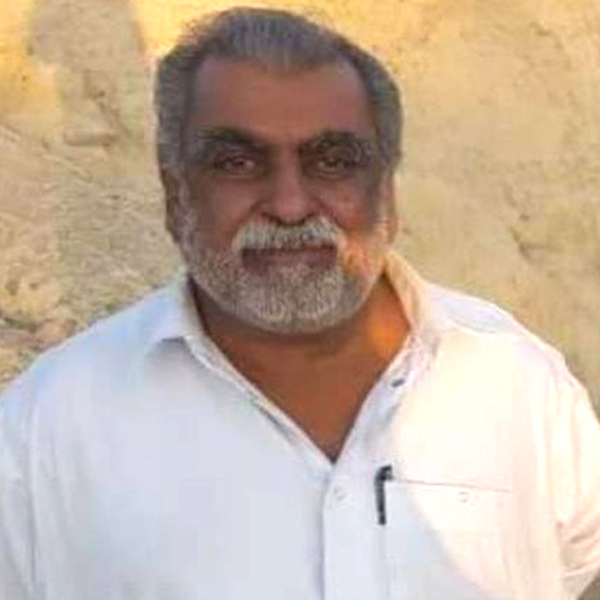
Ghaws Bahar
Introduction by Noroz Hayat and Carina Jahani
Ghaws Bahar (also spelled Ghaus Bahar) was born on 8 March 1954, in Ormarah, on the Makran coast of Balochistan, Pakistan. (171) After finishing his BA, he began working as a civil servant. Soon, however, Balochi language and literature became his main interest in life, and he later also became active in Baloch civil rights and politics.
Ghaws Bahar was an active member of the Baloch National Movement, (172) a political organization founded in 1987 to be a voice for the independence of Balochistan. (173) A number of the leaders and members of this organization have been killed or abducted over the years, (174) and Ghaws Bahar, too, faced death threats due to his political activism. As a result he had to leave Pakistan and take refuge in the Iranian part of Balochistan.
In Iran, Ghaws Bahar was mainly based in Sarawan, where he continued his literary work and joined together with Baloch literary activists. He also started classes in Balochi for his literary friends, (175) and even wrote a book about the Baloch literary activists in Sarawan, Mortagén Halkay Zendagén Mardom (The Living Souls of the Dead Land). It is unclear whether this book has been published. (176)
After some years in Iran, he was diagnosed with cancer and he returned to his home town, Ormarah, for treatment. The treatment was not successful, and he passed away on 8 August 2018. (177)
Ghaws Bahar was a poet and short story writer. His literary pieces were published in magazines and in a number of books, such as Zergwát (Sea Breeze), a short story collection; (178) Balóchi Daryáb (179) (Balochi Prosody), on Balochi poetry and its prosodic system; (180) Karkénk (Oyster) a short story collection; (181) and Abétkén Bolór (Gloomy Crystal), a collection of poetry. (182)
Ghaws Bahar also did translations from Urdu into Balochi. Among his translated books, Ájóiay Cherág (The Lamp of Freedom), written by a certain Ikramullah, can be mentioned. (183)
Ghaws Bahar also took part in the discussion on Balochi orthography. He published a book titled Balóchi Likwarh (Balochi Script), (184) and in an article published in 1984 he suggested that the Bengali script should be used for Balochi. (185) Toward the end of his life he also wrote a piece about the modification of the Balochi script made by the Balochi Language Project. (186)
Ghaws Bahar was a member of the Balochi Academy in Quetta. Founded in 1961, this institution works for the promotion of the Balochi language and its literature and has published a considerable number of books in Balochi as well as other languages on topics concerning the Baloch. (187) Most of Ghaws Bahar’s books were published by the Balochi Academy.
Ghaws Bahar engaged with societal issues not only as a political activist but also as a storyteller, narrating in a social realist style the true tale of the hardships of his people and his homeland. Similarly, he depicted criticism of his people’s disunity in his literary works. He always wished to convey the message of unity to his people. Moreover, being a poet, he had a poetic way of storytelling. In his literary pieces he often painted patriotic pictures to convey the beauty of his homeland and express his genuine fear that the state would forcibly turn the Baloch into a minority on their own soil.
The story Karkénk (Oyster), which is presented in this anthology, is told in the first person, and the protagonist is a young man who has just completed his education but is unable to find a job. Recalling that a year earlier he had met an old man, Uncle Tangahi, who made his living by gathering oysters, he decides to do the same thing. But on his first day “at work,” he is arrested and he subsequently finds out that an even more sinister fate has befallen Uncle Tangahi. Set in the coastal region of Balochistan, the story is full of subtle criticism of the political system and the people in power. Although there are clear indications in the story that it is set on the eastern side of the border dividing the land of the Baloch between Iran and Pakistan, the same events could certainly happen on the western side as well.
Stories by this Author
Oyster Shells
I had not picked up more than ten shells when four uniformed soldiers surrounded me. One tore the bag from my back and shook out the contents onto the ground. I was at a loss what to tell them when the butt of a rifle thudded...