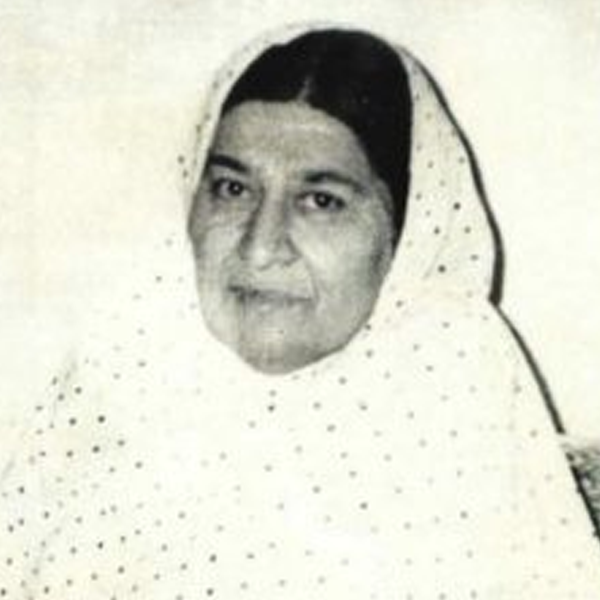
Gohar Malik
Gohar Malik (also spelled Gawhar Malek) was born on 26 August 1938 in Panjgur, Balochistan. She was the eldest daughter of the famous Baloch politician and poet Mir Gul Khan Nasir. (99) At the age of two she contracted polio and was left paralysed. Her family later moved from Panjgur to Nushki, where she grew up. In those days it was not yet possible for girls to pursue an education, but her father gave her the opportunity to study at home.
Gohar Malik began her literary career as a translator from Urdu into Balochi. Among the authors she translated are N. M. Rashid, Khalil Gibran, and Krishan Chander. Her translations were published from the mid-1950s onwards in the Balochi magazines Máhták Balóchi and Nókén Dawr. (100)
Gohar Malik began writing short stories in the 1960s, as one of the first female voices in Balochi literature, and the very first female short story writer in male-dominated Baloch society. By telling her female characters’ stories through female eyes, she is able to depict the emotions and struggles of women first-hand.
Gohar Malik was also interested in local traditions, such as customs around marriage and traditional herbal medicine. She took an interest in local idioms and proverbs, and frequently used them in her writings.
Another thing that was of great importance to Gohar Malik was the legacy of her father. She kept her father’s drafts and manuscripts in her possession, and was well acquainted with his rich poetic production. In fact, she knew many of Gul Khan’s poems by heart. She also composed her own poetry, but mainly kept it to herself. She passed away on 28 February 2000.
Gohar Malik’s literary style is simple, yet rich, and she is not afraid to treat taboo subjects, as in the story presented here, Santh (The Barren Woman). The theme is childlessness, something which is a disaster for a Baloch woman, and in the story the couple is childless for a reason that is not even discussed in the Baloch society. Gohar Malik succeeds in describing a woman’s dreams and aspirations in a realistic and vivid way. She then goes on to give an equally realistic picture of the protagonist’s discouragement when she finds out that the real world is far from her dreams.